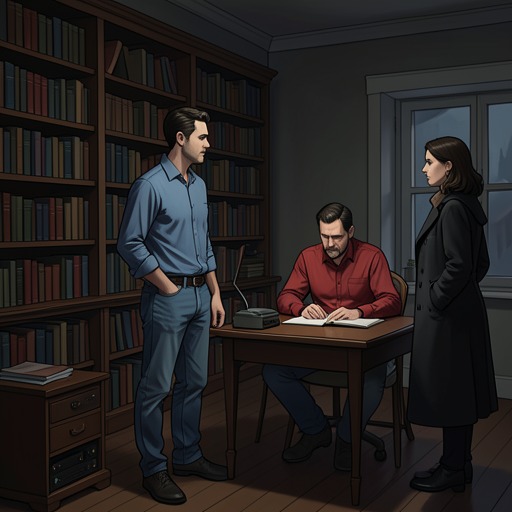
Harrison Scully—Jake Scully father-son relationship
Crimson LakeJake Scully and Harrison Scully’s father-son relationship turns on a painful reversal: Jake tries to protect and guide his son, while Harrison comes to experience that guidance as control. The novel links their family conflict to the image of an author and a character who has escaped his creator’s command, then gives that metaphor a devastating practical consequence when Harrison deceives Jake and leads him to his death.
Identity and the Authorial Metaphor
Jake is Harrison’s father, but their relationship is also considered through Jake’s work as a writer. In a letter addressed to Jake, the writer imagines what it is like for a character to be fashioned and moved around by an author. That reflection turns to Harrison: the letter describes Jake as having shaped his son over years, then losing control as Harrison begins to act and speak independently. The comparison does not erase their real family bond; it makes the limits of parental authority newly visible.
The letter recalls Jake sitting with Harrison in a courtyard and reaching out to touch him as Harrison pulls away. Jake’s expression is described as pained, and his attempt at physical closeness meets withdrawal rather than reassurance. The scene presents estrangement through a small gesture: a father reaches for his son, but cannot make the distance between them disappear.
The same passage connects Jake’s distress to his effort to regain control. As Harrison moves beyond the role Jake expected him to occupy, Jake returns to his keys in an attempt to bring him back within the story’s limits. The letter frames this as an impossible task: a son, like a character, has a fate that is no longer simply his father’s to write. This image foreshadows the larger conflict without making the two roles identical; Jake’s authorship becomes a way of understanding his wish to direct Harrison, not proof that Harrison is merely fictional.
Conflict Over Harrison’s Future
Harrison later describes Jake’s intervention as a continuation of opposition to his relationship with Zoe Miller. He says that Zoe’s mother, Teresa Miller, had opposed the couple from the beginning, and that after Teresa’s death he felt Jake had taken up the same effort to separate them. Harrison also says Jake intended to send him to a six-month rehabilitation program for troubled youths because of the relationship. In Harrison’s account, the prospect of being sent away confirms his belief that his father is trying to break the couple apart.
Harrison’s explanation is shaped by grievance rather than reconciliation. He describes himself as subject to Jake’s power and says he felt like a slave, while the earlier courtyard scene shows the father still attempting closeness. Their accounts of the bond therefore pull in opposite directions: Jake appears as a parent reaching toward a withdrawn son, while Harrison interprets parental concern and discipline as an attempt to control his future. The gap between those perspectives helps explain the relationship’s tragic turn, but does not make Harrison’s later deception inevitable or excuse it.
Harrison also links the conflict to the killing of Teresa. He says the initial plan concerned her, because she opposed him and Zoe, and that after her death they began considering further killings. He presents Jake’s effort to send him away as a return of the same threat of separation. The evidence establishes this as Harrison’s account of his motives; it does not turn his explanation into a justification for the choices he makes against his father.
The Deception and Jake’s Death
Harrison’s betrayal exploits Jake’s protective concern for him. The last letters attributed to an obsessive fan threatened Harrison, and Jake was worried about what the supposed fan might do to his son. Harrison then woke Jake with a fabricated message: he claimed that someone online wanted to meet him by the river and speak about Jake. Jake went in Harrison’s place, believing he could confront the threat and keep it away from his son. The danger was not an outside pursuer, as Jake had been led to think, but Harrison himself.
The pier trap repeats the deception in physical form. Harrison had lured his father out of bed with the false account of a stranger’s threats, then led him through a section of the pier prepared to give way. In the narrator’s recollection, Jake tries to hold on as he falls, looking toward the boy at the end of the pier and recognizing that the supposed stranger is his own child. The trap makes the father’s protective choice the means by which Harrison gains control over him.
Meaning of the Relationship
The relationship’s central irony is that Jake’s wish to keep Harrison safe becomes the opening Harrison uses to kill him. Jake acts on a father’s fear for his son, while Harrison turns that care into leverage. The courtyard reach and the night-time lure form opposing gestures: first Jake reaches toward a son who draws away; later the son summons the father under false pretences, knowing Jake will come because he is concerned for him.
The author-and-character image gives the conflict a second dimension. Jake’s difficulty accepting that Harrison has become independent is mirrored by Harrison’s resentment of being directed, yet the story refuses a simple equivalence between a writer’s control over a character and a parent’s responsibility toward a child. In the end, Harrison claims the power to decide his father’s fate, and the pier trap converts their unresolved struggle over control into an irreversible separation.